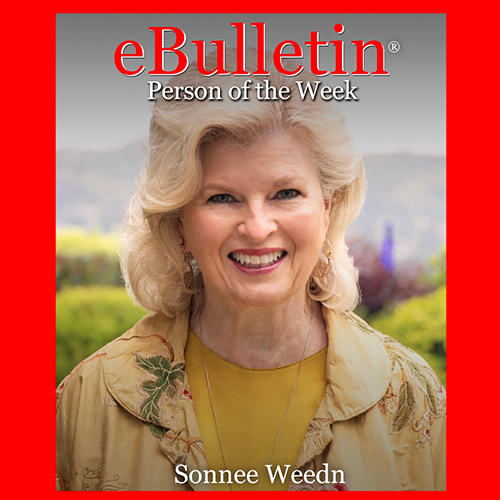
Dr. Sonnee D. Weedn is a clinical, forensic and neuropsychologist. She has been in private practice for 46 years with offices in Novato and Newport Beach, CA. She is the author of several books, including, “Many Blessings: A Tapestry of Accomplished African American Women,” featuring interviews with 30 amazing contemporary women, and a workbook series, “8 Ways To Wellbeing for Recovering People,” “8 Ways to Sustainable Wellbeing for Teens and Families,” with Jamison Monroe, and “8 Ways to Wellbeing for Reliance Vitality,” with Jan Kingaard, all based on the research of Dr. Roger Walsh at UCI.
She has twice presented by invitation of His Holiness the 14th Dalai Lama at the Tibetan Medical Society in Dharmsala, India.
She is able to perform comprehensive brain evaluations and cognitive restoration, using technology developed by engineer and rocket scientist, Dr. Curtis Cripe. She is an affiliate of his NTL Group.
Q. If you are in recovery, what was your drug(s) of choice and when is your sobriety date?
A. I am not a recovering person. Drugs and alcohol never interested me much. I’m the girl who asks the bartender if he/she will sell me a half glass of wine because I won’t drink the rest and its a waste of money and wine. But, I had a pre-doc internship in a hospital treating chemical dependency and loved the work and the emphasis on Higher Power, an element I thought was missing from traditional psychotherapy. My name went around at AA and NA and pretty soon most of my practice was recovering people or people seeking recovery, or who needed it even if they weren’t seeking it. It became my area of specialization and I have consulted at numerous treatment facilities across the U.S.
Q. Do you think addiction is an illness, disease, a choice, or a wicked twist of fate?
A. I think addiction is complex and unique to the person suffering. Some of the complexity has to do with genetics, neurological factors, environment, social influences, and other factors. This complexity is the reason I believe that so many people relapse after traditional treatment. Treatment that does not or cannot take all these factors into consideration and provides essentially, “cookbook” treatment simply does not work, as the statistics bear out.
Q. Where are you from and where do you reside now?
A. I was born in Minneapolis, MN. When I was three, my father, a Marine Corps fighter pilot was called up for the Korean Conflict. We were transferred to Newport Beach, CA. At that time, Corona Del Mar and much of Newport Beach was home to military families. Our block in Corona Highlands was almost all fighter pilots.
Now I divide my time between Newport Beach and my home in Marin County in Northern CA.
Q. What is one word you would use to describe yourself?
A. Adventurous.
Q. If you ever retire, would you prefer to live by the ocean, lake, river, mountaintop, desert, or penthouse?
A. I will always live near the ocean.
Q. How do you measure success?
A. I measure my success by my long-standing friendships (some over 75 years!), my marriage of 56 years and the many wonderful relationships I have with friends and colleagues, for whom I have great love and respect.
Q. If you had an extra million dollars, which charity would you donate it to?
A. My husband and I help to raise funds for an orphanage in Northern India. The monk, Lama Tenzin Choegyal, who manages all the children there is a dear friend, and when I have extra money, I give it to his fiscal sponsor, Partnerships for Change in San Francisco for him and his children.
Q. Who has been the biggest influence throughout your life?
A. My mother, Delight Wiseman was my biggest influence. Though we had a complicated relationship, I miss her practical wisdom, her ability to create a beautiful home, no matter if it was half of a quonset hut on a military base or a small home at the beach, her love of flowers, her being instrumental in helping legislate pubic special education for neurologically handicapped children, her stamina in raising my brother and I and my handicapped sister taking real joy in all of us, and her deep devotion to her spiritual practice, which was not exclusive. My mother worked for Civil Rights when we lived briefly in the segregated South. She was an activist!
Q. Who made you feel seen growing up?
A. I was so fortunate to have a fabulous grandmother, Delight Church. If you ever saw the movie, “Auntie Mama,” my grandmother was exactly like the character played by Rosalind Russell. She adored me, encouraged me and was an amazing role model of a woman who was a feminist, a successful business woman, with sense of style that was sensational and a spirit that was indefatigable!
Q. Which living person do you most admire?
A. I most admire His Holiness the 14th Dalai Lama. I have had the privilege of being in his presence on four occasions and was allowed to ask him a question during a private audience. His courage, kindness, laughter, inclusiveness, and wisdom inspire me.
Q. What sound or sounds do you most remember from your childhood?
A. For most of my childhood I lived near the ocean. I could hear the waves breaking if it was really quiet. I could hear seals barking, the fog horn on foggy nights and the sound of the bell buoy bobbing in the waves.
Q. Which part of your treatment and recovery do you feel was the most interesting or unexpected?
A. I have been in therapy off and on throughout my adult life. But, I would say that the most healing experiences I had came from a Navajo Medicine Man, Albert Sombrero, to whom I was apprenticed for many years. Albert had a way of approaching healing that was powerful, magical and unforgettable. He had two Master’s degrees, but mostly practiced in traditional Native ways. Albert is gone now and I now draw inspiration and healing from Yaqui Spirit Guide, Lench Archuleta, another very educated man, who practices in traditional Native ways.
Q. What’s your concept of a Higher Power?
A. Though I was raised in a very liberal Christian family and have belonged to the Sausalito Presbyterian Church for fifty years, my Higher Power is much, much bigger than any one religious or spiritual path. I love most all traditions and am fascinated by the many ways in which we humans attempt to approach the Divine.
Q. What is your Astrological sign?
A. Aries.
Q. Which film have you watched the most?
A. The Wizard of OZ. I love the magical retelling of the Hero’s Journey! We do have the magic all the time! We just have to learn how to use it.
Q. Who is your favorite film director?
A. Frank Marshall. I went to High School at Newport Harbor High School with Frank. He not only makes great films, he is a kind and generous person. I see him at high school reunions.
Q. What book would you most like to see turned into a movie or TV show that hasn’t already been adapted?
A. I am actually turning Dr. Joycelyn Elders’ autobiography into a documentary. We are currently finishing up filming and her story of rising from the cotton fields of rural Arkansas during legally enforced segregation, to be Surgeon General of the USA, only to be forced to resign for speaking openly about issues of public health having to do with sex education, is truly a remarkable and inspiring story. I can’t wait for it to be finished this year and ready for distribution next year.
Q. Are you binge watching any TV series?
A. I have watched the “Outlander” series several times. I am so sad that the story of Jamie and Claire is coming to an end this season.
Q. What are some of the most memorable songs in your life?
A. Whenever someone asks me my favorite song, I always have the same answer, “The Power of Love,” by Huey Lewis and the News.
Q. What is your favorite city?
A. Dharamshala, India. It feels exotic and the energy of His Holiness the 14th Dalai Lama feels palpable to me. Shopping and cuisine are wonderful and it is magical to see the Himalayas in the distance. One can hear monks chanting early in the morning and visit the monasteries for morning prayers and ceremony. Exquisite!
Q. What is the best and or worse piece of advice someone has given you?
A. The best piece of advice I ever received came from my professor at USC, Dr. Leo Buscaglia. He said, “Sonnee, you really need to get your Ph.D. Don’t stop at a Master’s degree! Keep going.” I followed his advice.
Q. What is your most treasured possession?
A. I am a collector of treasures, so it is hard to choose, but I am grateful to have inherited two watercolors and an original sculpture of a Medicine Man by the famous artist, Charles M. Russell. I have had a number of artifacts from him that I have given to the museum in Great Falls, MT. But, these items I have kept.
Q. What is your biggest fear?
A. I am very afraid of losing my dear husband. We have been married for 56 years and he is not only my best friend, but truly the wind beneath my wings. We have had SO much joy and fun over the years. No one can live forever, but I want to be with him for as long as possible.
Q. Where do you go when you’re seeking solitude?
A. I have a particular little beach I love called China Cove in Corona Del Mar, CA that I love. If I happen to be in Little Rock, AR, I love the AR House of Prayer that is a magnificent building dedicated to silence.
Q. What is the greatest risk you’ve ever taken?
A. The greatest risk I have ever taken was to leave my job as a public school teacher and go into private practice as Marriage and Family Therapist and a Clinical and Forensic Psychologist. It was a huge leap of faith and I am so grateful that I had fabulous mentors to guide and direct me so that I never looked back.
Q. What do you love most about yourself?
A. I appreciate that I am a curious and compassionate person. I think that to be a good psychologist one must be both. I truly love my clients and I learn so much from them.
Q. What is your greatest extravagance?
A. Travel is my greatest extravagance. I love visiting new places and old favorites. I love foreign people, foreign food and having adventures. I was outside Mexico City twice last year to be near the pyramids at Teotihuacan. I try to get outside the country when I can, but also love U.S. travel.
Q. When did you realize you were a grown-up?
A. When I was twenty-five, I was a kindergarten teacher. My room mothers had come to set up for an Easter party and I had taken the children outside so that they could get everything ready for the party. One of the mothers had a seizure and the nurse called an ambulance. Nancy was taken to UC San Francisco. She had had an aneurism and was scheduled for surgery the next morning. I called her and asked if she had someone with her. “No.” I asked if anyone was coming. “No.” I did not know her well, but asked if she would like my husband and I to drive into San Francisco and bring her dinner. She said she would really like that and asked for a pastrami sandwich from Max’s. My husband had never met her. Off we went to have a little picnic in her hospital room that night. She died on the operating room the next morning. Rob and I were her only visitors.
Q. How important are your pets to you?
A. I have had pets all my life; cats, dogs, hamsters, guinea pigs and birds. I have especially loved my cats and dogs, but I travel by airplane now weekly between two offices and cannot have a pet now. Maybe next year!
NEWS YOU CAN USE
Subscribe Today! The Addiction Recovery eBulletin is your best source for current news, information and opinions about the issues that matter to you most. Serving the treatment industry, recovery community and health and wellness professionals.