



THINGS CHANGE –
Dec. 2025 – By gatecrashing our brains, alcohol has shaped human history, from our ancestors’ descent from the trees to the formation of modern cities. Yet because it brings misery and sickness as well as joy and conviviality, our species’ love affair with it is on the rocks. Sales are sliding in rich countries some think global consumption has peaked. Is the greatest party of all time coming to an end? To answer this question one needs to understand a relationship whose molecular fingerprints are first visible millions of years ago.
A good place to start is with biochemistry. Ethanol is so toxic that most animals that consume it either quickly get drunk or poison themselves. Humans, unusually, have a pair of enzymes that turf it out like night-club bouncers. Our ability to process alcohol has deep evolutionary roots.
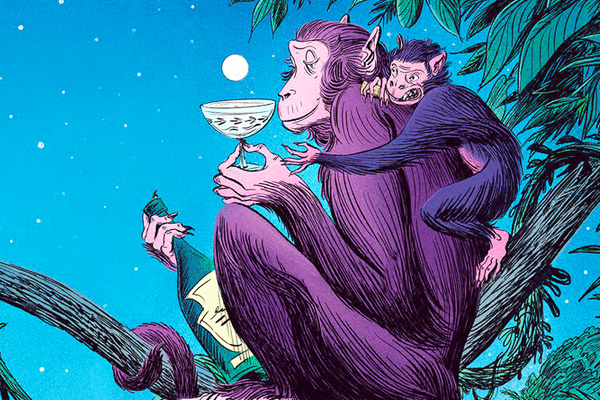
Ten million years ago a common ancestor of humans, chimpanzees and gorillas acquired a mutation that let them remove ethanol from the body more efficiently. This adaptation coincided with a change of habitat. Tropical forests were collapsing, notes Robin Dunbar of Oxford University. Some 90% of apes went extinct. One lineage survived by leaving the trees and foraging on the ground.
Whereas apes in trees gobbled fresh fruit, those on the ground found fallen fruit, which ferments. Thus, our ancestors may have acquired a taste for alcohol–which allowed them to use these scarce calories. This “drunken monkey” hypothesis suggests that a love of the smell and taste of alcohol, the sign of an energy-rich fruit, gave our ancestors an edge. Their chosen poison would have been fairly weak. A study of overripe wild Panamanian palm fruits found none stronger than 5% alcohol—about the same as a Heineken.