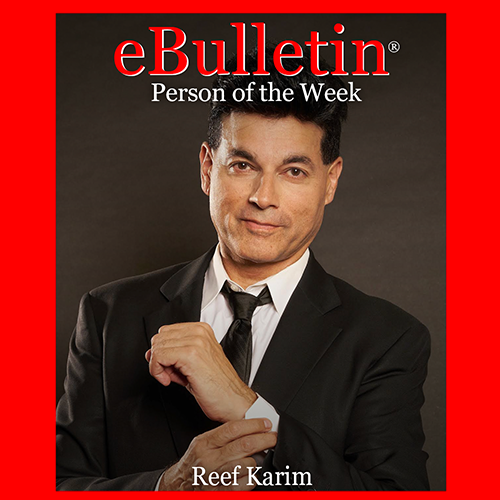
Reef Karim is the rare triple threat of scientist, healer, and award-winning entertainer, who is expanding the minds of people all over the world. Dr Reef is a transformational scientist, humanistic psychiatrist, and addiction specialist who served over a decade as an Assistant Clinical Professor at the UCLA Semel Institute for Neuroscience, published in prestigious medical journals, and owned, operated, and exited a highly successful mental health treatment center. He’s been interviewed by Oprah, Larry King, Deepak Chopra, Anderson Cooper, and many others. Forbes pens, “Dr. Reef Karim has worked with a who’s who of A-List Actors, Rock Stars, Royalty, Professional Athletes and Fortune 500 CEO’s” Dr. Reef is the CEO of The Mad Genius Company for disruptive communication (madgeniusexperience.com) and the founder of the personal transformation platform, Master The Madness (masterthemadness.com).
Q. If you are in recovery, what was your drug(s) of choice and when is your sobriety date?
A. I am not in recovery. Have published, taught medical students and residents about dual diagnosis and chemical and behavioral addictions, have owned and operated mental health and addiction treatment centers, had academic titles, and worked in community outreach in the media to help educate and de-stigmatize addiction, mental health, and dual diagnosis. I’m a big advocate for the recovery community and continually work to provide insight and myth bust.
Q. Is there anything special in your sobriety toolkit that helps keep you sober?
A. Not in sobriety.
Q. Do you think addiction is an illness, disease, a choice, or a wicked twist of fate?
A. I believe addiction is a spiritual condition with biological, psychological, and social implications. A compensatory response to both trauma and a poor self-concept. Without an existential, spiritual, and transformative shift in meaning, vision, and self-concept, it is very hard to truly transform one’s life. It is very possible to be clean and sober with the right support and treatment, but it’s much more challenging to live an inspired, passionate, and purposeful life without deeper insight and a shift in how one sees themselves and their place in the world as this requires a deeper existential and spiritual shift. To be stuck in cognitive rigidity without the skills, insight, and spark to elicit change, is a very tough place to be.
Q. Where are you from and where do you reside now?
A. I am from Chicago (huge Illini, Bears, Bulls and deep dish pizza fan). I live in Los Angeles (good weather).
Q. If you ever retire, would you prefer to live by the ocean, lake, river, mountaintop, desert, or penthouse?
A. Ocean.
Q. How do you measure success?
A. I measure success by the GAP between doing what truly makes us come alive and truly gives us meaning vs. what we are currently doing now. I don’t measure success by financial currency. I measure success by inspirational currency (and if you’re inspired, you have a much higher chance of productivity, legacy, and financial growth).
Q. What is your biggest pet peeve?
A. People that have strong opinions without doing any work to form that opinion (through experience, research, training).
Q. If you had an extra million dollars, which charity would you donate it to?
A. Child Creativity Lab Foundation to support the utilization of creative methods to overcome traumatic experiences and limiting experiences. To start expand minds at a young age.
Q. Who has been the biggest influence throughout your life?
A. The biggest influence in my life, both extremely positive, and occasionally negative, is my mom. She stood by us during very difficult and challenging times. She loved me and watched out for me and protected me. She also passed on her anxiety, limitations, critical defense strategy, attachment challenges, and immigrant fear. Life is all about taking the best from your childhood, healing from the pain, and passing on our best to our children. And my life is no different. My mom has been my biggest influence and I cherish her for it.
Q. If you could give advice to your younger self what would it be?
A. I would say “go for it” more and figure out how to do it later. I have taken risks in life but I’ve also taken into account what others might say, or might do, as a result. I’ve been afraid of change too often. When we are able to accept that life is all about change and you aspire to build a foundational inner circle (life partner, kids, family) and everything outside of that circle WILL change, you develop more skill and experience for adaptation, taking strategic risks, and cognitive flexibility without stress or impression management getting in the way.
Q. Who made you feel seen growing up?
A. I grew up in a very challenging family where EVERYONE feared being seen. I was literally told NOT to be seen. Not to stand out. Not to do anything where we could be noticed (good or bad). Coming from a background where my ancestry had been kicked out of various countries, our ancestry was raised on NOT being seen. To just quietly fit in. It was a survival mechanism engrained in our heritage.
As a result, I felt very trapped in my family, my surroundings, and our fear conditioning. The only time I felt seen was when I played a character who was not me. Who was not stuck or trapped in my situation. That’s why I became a skilled actor because those characters could end up in situations I wouldn’t be in; they could live life and extend themselves when I wasn’t able to. I LOVED storytelling, character development, and the creative process of inhabiting a scripted world where the characters could grow and have opportunities to experience life in ways I couldn’t.
Q. From what school of thought or teacher did you learn the most from?
A. The two thought leaders I gravitate to are: Carl Jung & Jalaluddin Rumi. I’ve always connected with Jung’s work on the collective unconscious, archetypes, creativity, self-discovery, and individuation. And coming from a Sufi background, I connect just as much with Rumi’s profound poetry and spiritual insights on love and the deeper connection we all seek within ourselves.
Q. What is a phrase that has kept you sober during challenging times?
A. I’m not in recovery but I love the phrase, “I used drugs to FEEL better. I quit drugs to BE better”.
Q. What major event or realization shaped who you are?
A. I’ve had lots of smaller events that have shaped who I am but three major events sparked realizations and revelations that changed the course of my life.
When I was fresh out of college, my Indian parents staged an intervention on me, NOT because I was doing drugs, but because I didn’t want to go to medical school. Call it an Indian career intervention. It’s funny now but wasn’t funny at the time. After the intervention, I realized my parent’s identity and health was very much tied to my career choice and I would essentially need to “martyr” my life to make their life feel more acceptable. That was the day I realized my life was not my own. And this defeated state would stay with me for decades.
The second event that really shaped me was when I was accidentally held up at gunpoint in central Turkey because my assigned guide was essentially a fugitive (unknown to the medical exchange program I was working with). After it was all over, while visibly shaken, I was helped by a wise Sufi mystic healer who spent time with me sharing philosophy and different ways to see the world and our place in it. This planted the seed for what would become my signature platform on human potential and personal meaning thirty years later.
And the third event was my son being born which immediately switched my life motivation and inspiration from more ego driven to impact and legacy driven.
I know kids do this to a lot of us and it definitely did it to me, instantly.
Q. What do you love most about living sober?
A. I love coming alive and helping others find what makes them come alive.
Q. What is something you swore you would never do, but did anyway, in recovery?
A. I’m not in recovery.
Q. What’s your concept of a Higher Power?
A. I see our “higher power” as our inner knowing, our energy of inspiration, our originality, our drop (as Rumi says we are the collective ocean in a drop). Now you could say that inspiration, that inner knowing, comes from a higher source and it’s our job to tap into that energy (and originality), OR abandon it, or let it sit in hibernation where we never access our potential, or know what we could be, or what we could accomplish. Unfortunately, I believe most people never access their potential and are left “wanting” while the rare ones who spend the time to explore their unconscious and personal meaning, are then able to develop their soulful expression, come alive, and operate their life powered with this inner direction. This is the work I do now. Helping people develop the cognitive flexibility, creative vision, and unconscious exploration to see beyond their current circumstances and learn to craft their story and tell their story to attract new opportunities and relationships.
Q. Who is your favorite celebrity in recovery?
A. Danny Trejo. He’s had a challenging journey. We have worked at the same events sharing education, insight, and inspiration in the recovery community.
Q. What book(s) have you read more than once?
A. Parenting From The Inside Out (Dan Siegel). The Myth of Normal (Gabor Mate).
Q. What books are you reading now?
A. Behave (Robert Sapolsky). Meditations (Marcus Aurelius).
Q. If you were giving a dinner party for your 3 favorite authors, living or dead, who would they be?
A. Jung. Maslow. Rumi.
Q. Which film have you watched the most?
A. Gladiator.
Q. Who is your favorite film director?
A. Paul Thomas Anderson.
Q. Are you binge watching any TV series?
A. Narcos.
Q What is your favorite App?
A. There are so many. Don’t have a favorite.
Q. Who is your favorite performer, living or dead?
A. Elvis (with Prince a close second).
Q. What is your favorite hotel?
A. Marriott Bonvoy Hotels Overseas.
Q. What are some of the most memorable songs in your life?
A. Carless Whisper (Wham) (first slow dance). Somebody’s Baby (Jackson Brown) (first crush on a Hollywood Actress). Staying Alive (The Bee Gees) (got me into dance). Lonely Teardrops (Jackie Wilson) (first lip sync dance performance). Love Bites (Def Leppard) (first lonely breakup song).
Q. What is your favorite city?
A. Rome (for the ancient and modern mixed in together).
Q. What is your favorite restaurant?
A. Charcoal Steakhouse.
Q. What is your favorite cuisine?
A. French Cajun.
Q. What is a style trend you wish would come back?
A. Disco & ’70s Outfits.
Q. What are five things you always carry with you?
A. Water. Glasses. Beats Ear Buds. Elvis Rhinestone Hat. My Son’s Homemade Keychain.
Q. What is the best and or worse piece of advice someone has given you?
A. Best: When you’re really ready to say something, that’s the time to write the book and share your message. So many people want to hear their voice; they want to feel like they matter and they do so reactively without investigating who they are and taking the time to develop themselves in personal discovery. When you have enough life experience, and you’ve processed what that means to you, and you’ve developed a point of view based on your innate abilities, training, and personal experience, and then you feel called to really say something, that’s when you get out there and share your message and share your voice.
Worst: Start before you’re ready. I consider this bad advice because you want to be distinctive, to offer something new or better, to idea generate not out of conformity or stress but out of originality, for business and for your personal life, and that takes time and a concerted effort to really get behind your idea. When you “start before you’re ready”, it’s often an idea rooted in conformity that you’re not fully behind with confidence and conviction, and those ideas often fail, and then you think you’re a failure instead of realizing that you didn’t have a novel and out-of-the-box idea to start with and you weren’t fully emotionally invested in this idea.
Q. What is the best piece of advice you’ve given someone else?
A. Take the time to figure out WHO you are. Why you’re on this planet. What you feel called to do. And build a business, a life, and relationships, around that. When you operate from within, and truly come alive, you’ll attract the right opportunities and right people into your life.
Q. What is one thing that always makes you smile?
A. Little kids crawling and waddling around.
Q. Is there anything you do that seems mundane on the surface but has turned out to be sacred for you?
A. Dancing. Partner Dancing on the surface seems like just a fun hobby. But, it’s brought me so much in life. Dancing helped me transform from an awkward, repressed nerd to a fully expressed, confident and charismatic go-getter. Dancing helped me connect my mind and body. Dancing brought me elevated levels of cognitive flexibility. Dancing led me to my wife. Dancing led to the birth of my son. We can dance when we’re young, middle-age, or old. Dancing is all about connection; connection to the music, connection to our body, connection to our environment, and connection to another person (in a time when basic human touch is so important). I always say, “partner dancing is having a 3 minute conversation with another human without saying a word”
Q. What do you consider your greatest achievement?
A. The proudest moment of my life was seeing the birth of my son.
Q. What is your favorite compliment to receive, and why?
A. ”You’re innovative and disruptive.” I like to challenge the status quo, especially when it’s holding a lot of people back and challenging our mental health.
Q. What is your biggest fear?
A. My biggest fear is not being a good father. I always strive to learn from my childhood, and break through my past conditioning, to be the best Dad I can be.
Q. Where do you go when you’re seeking solitude?
A. I go to an area of my home called “the creative cave” and either listen to music, create, or sit in silence.
Q. Which talent would you most like to have?
A. I’ve always believed in my potential and skills and never given up on the dream, even when faced with negativity, naysayers, and seemingly constant criticism.
Q. What is your biggest regret?
A. I try not to regret. I know I’ve made lots of mistakes, hurt others, hurt myself sometimes, and could have done things differently, but it’s all part of my journey in becoming a better person.
Q. What is the greatest risk you’ve ever taken?
A. The greatest risk I’ve taken is walking away from the stability and status of the traditional doctor life for the instability and unknown of the entrepreneur, entertainer, and thought leader where you really have to think out-of-the-box and innovate to move your industry forward. I wanted to help people develop the insight, personal meaning, and skills to activate their potential, tell their story, and connect who they are with what they do. Becoming more self-expressed and inspired has been my core journey (coming from a childhood and family that is not expressed) and helping others to do the same, personally and professionally, is my mission.
Q. What is the hardest amends you’ve ever had to make?
A. I’ve made some amends and will continue to make amends. Every amends is a hard amends.
Q. What is something you’ve learned about yourself in the last six months?
A. I’ve learned that my compartmentalized life (scientist, healer, & entertainer) can be integrated and accepted by the general public. This has been a big challenge in my life and I didn’t know how to integrate.
Q. What is something you are currently curious about?
A. The impact of AI on our innate feeling about ourselves (self-concept) and our authenticity.
Q. What do you love most about yourself?
A. That I’m adaptable to my environment, always willing to grow, and constantly curious in the pursuit of wisdom and personal meaning.
Q. What do you like most about 12-step meetings?
A. The camaraderie, support, and vulnerability.
Q. When did you realize you were a grown-up?
A. When my son was born. But, to be honest, I don’t know if I’ve realized it yet. I don’t really want to realize it.
Q. How important are your pets to you?
A. I don’t have a pet but would love a dog.
SIGN UP TODAY!
Subscribe Today! Your best source of current news, information and opinion about the issues that matter to you most. Serving the treatment industry, recovery community and health and wellness professionals.